Google Cloud ACE Load Balancing and Network Tiers Guide
Study Google Cloud ACE Load Balancing and Network Tiers: key concepts, common traps, and exam decision cues.
This lesson is about planning the network path before deployment. ACE expects you to know when the real question is about traffic distribution, region availability, or the performance and cost trade-offs in Google Cloud networking.
Service tier: Google Cloud network-performance and pricing model that affects how traffic uses Google’s network.
Resource location: Geographic placement of a service or dataset, which affects latency, availability, and sometimes compliance.
Regional load balancing: Load-balancing scope that keeps the frontend and backend decision inside one region rather than treating the whole path as global.
What Google Cloud is really testing here
Google Cloud wants you to separate:
- traffic distribution from pure placement choice
- global entry-path design from regional-only design
- latency and resiliency goals from cost-only thinking
- resource location from service-tier selection
Load-balancing chooser
| Need | Strongest first fit | Why |
|---|---|---|
| one global entry path that can reach backends in multiple regions | global load balancing | The decision scope is worldwide, not single-region |
| traffic distribution that stays inside one region | regional load balancing | The requirement is regional, so a global answer is broader than needed |
| best Google backbone path and strong global performance | Premium tier | Premium is the higher-performance global network lane |
| lower-cost path when the requirement is regional and simpler | Standard tier | Standard is usually the leaner fit when global network reach is not the point |
| latency, compliance, or data-residency planning | deliberate region or multi-region selection | The location itself is part of the requirement |
Global versus regional mental model
The diagram below is the fastest way to avoid mixing up a global entry-path problem with a regional-only problem.
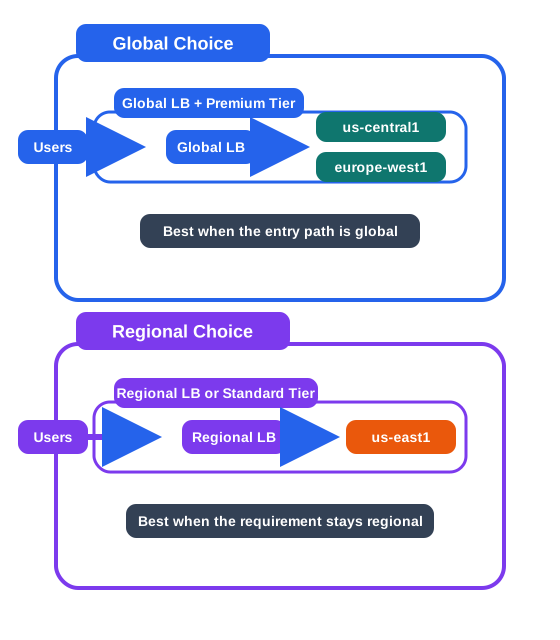
The key thing to notice is that global and regional do not just mean “larger” versus “smaller.” They change where the frontend decision happens and how much geographic scope the design is supposed to cover.
Location-planning traps
| Trap | Better reading |
|---|---|
| “Any region is fine because the service is cloud-hosted.” | Region still affects latency, resilience options, and sometimes compliance. |
| “Premium tier is always required.” | It is strongest when the requirement is global performance, not just because it sounds better. |
| “Regional load balancing is weaker by definition.” | It can be the cleanest answer when the service and users are intentionally regional. |
| “Load balancing and location are separate forever.” | They are linked because frontend placement and backend geography interact. |
If the question is really about service tier
| If the stem emphasizes… | Strongest first reading |
|---|---|
| best-performing global path | Premium tier |
| simpler regional cost control | Standard tier |
| request distribution and backend health | load-balancer choice |
| legal or geographic placement | resource location choice |
Harder scenario question
A company serves customers from multiple continents and wants one frontend path that steers users efficiently to healthy backends in more than one region. Cost matters, but the stem emphasizes global performance and availability first. What is the strongest reading?
- A. Treat it as a pure subnet-planning problem
- B. Prefer a global load-balancing design on the stronger global network path
- C. Pick Cloud Storage lifecycle rules first
- D. Keep everything regional because regional is always cheaper
Correct answer: B. The requirement is about global traffic entry and multi-region distribution first. Cost still matters, but it does not override the core path requirement.
Decision order that usually wins
- First classify the question as traffic distribution, resource location, or network service tier choice.
- If the requirement is balancing traffic for availability and scale, think load balancing first.
- If the requirement explicitly stays within one region, think regional rather than global.
- If the stem emphasizes Google’s highest-performing global network path, think Premium tier.
- ACE usually rewards matching the geographic and performance clue before choosing a lower-level setting.