AIF-C01 FM Evaluation, Metrics and Business Fit Guide
Study AIF-C01 FM Evaluation, Metrics and Business Fit: key concepts, common traps, and exam decision cues.
Model evaluation on AIF-C01 is about outcome quality, not just abstract benchmark scores. AWS wants you to connect metrics and testing back to the real business objective.
Evaluation criterion: Standard used to judge whether model output is good enough for the real use case.
Latency budget: Maximum response delay the business or user experience can tolerate.
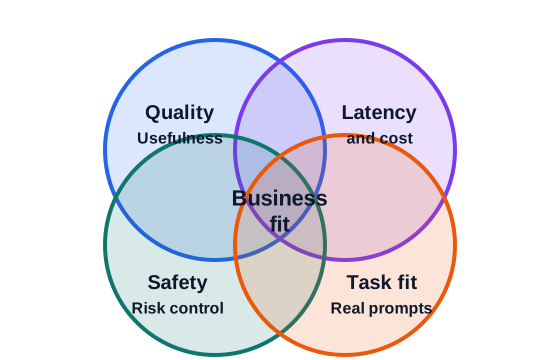
Business fit: Match between model behavior and the real constraints of the product, including quality, safety, speed, and cost.
What AWS is really testing here
AWS wants you to separate:
- generic benchmark scores from real business value
- output quality from deployment viability
- offline evaluation from production decision-making
- “best demo answer” from “best overall fit under actual constraints”
What strong evaluation does
- defines success criteria before rollout
- measures whether output is useful, accurate enough, and safe enough
- compares quality against latency and cost
- tests with representative prompts and scenarios
Evaluation chooser
| Situation | Strongest first evaluation lens | Why |
|---|---|---|
| customer-facing answer quality matters most | task quality plus safety | The output must be useful and not harmful |
| two models are close in quality but one is much slower | latency and business fit | AIF-C01 expects constraint-aware choice, not benchmark worship |
| a use case has strict budget limits | quality versus cost trade-off | The model still has to fit the product economics |
| the use case is highly variable across prompt styles | representative scenario testing | One polished demo does not prove broad reliability |
| the use case is regulated or high-stakes | stronger safety and human-review criteria | Fit is not only about fluency or raw answer quality |
Business-fit lens
The strongest answer is often the model that is good enough across the full decision surface, not the one that wins one benchmark column.
Metric categories by use case
| Use case cue | What to emphasize |
|---|---|
| question answering or support | answer quality, groundedness, safety, latency |
| summarization | faithfulness, clarity, token cost, latency |
| classification or extraction | accuracy, consistency, error rates, throughput |
| creative ideation | usefulness, style fit, safety, iteration speed |
Common traps
- choosing the model with the highest generic benchmark without checking business fit
- ignoring latency and cost constraints
- treating one good demo as a complete evaluation
Harder scenario question
Two models produce similar answer quality on a support-assistant pilot. One is slightly more fluent but slower and more expensive. The other meets latency and budget targets while staying within the safety bar. What is the strongest reading first?
- A. Choose the slightly more fluent model no matter the cost or speed
- B. Choose the model that best fits quality, latency, cost, and safety constraints together
- C. Ignore evaluation and rely on a launch-day demo
- D. Pick the largest model because it sounds more advanced
Correct answer: B. AIF-C01 emphasizes business fit across multiple constraints, not only the most impressive isolated benchmark.
Decision order that usually wins
- Decide whether the stem is about model quality, business fit, safety, or comparison workflow.
- Evaluate before deployment or scaling.
- Match the metric or rubric to the real business requirement.
- Compare models or prompts with evidence rather than vibe-based preference.
- Keep evaluation separate from production-serving and governance controls.